
The following new developments are worth noting in this area:
A. Civil law
Product-related civil law will be shaped in 2026 by the expansion of information requirements for consumers and the introduction of a right to repair.
I. New information requirements towards consumers
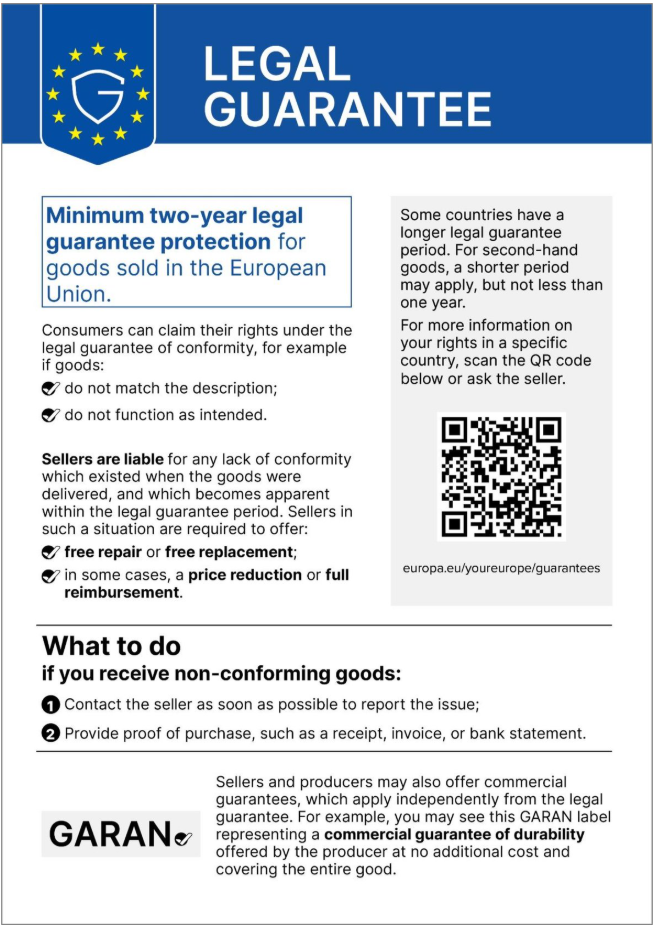
As previously reported, the EmpCo Directive introduces new information requirements for stationary and online retailers in addition to competition law prohibitions (see below). These relate to the existence of legal warranty rights on the one hand and mandatory information in the case of a commercial durability guarantee on the other. In future, the existence of the legal warranty right and its most important elements, including its minimum duration of two years, must always be pointed out. If the manufacturer offers a commercial durability guarantee for the entire product at no additional cost for more than two years, this guarantee must also be pointed out separately. These changes are incorporated in the EGBGB in Germany; the corresponding implementation law is now available.
The Commission recently laid down the specific format of this information in Implementing Regulation (EU) 2025/1960.
The harmonised notification regarding the legal warranty is to be as follows:
The reference to the commercial durability guarantee will be worded as follows:
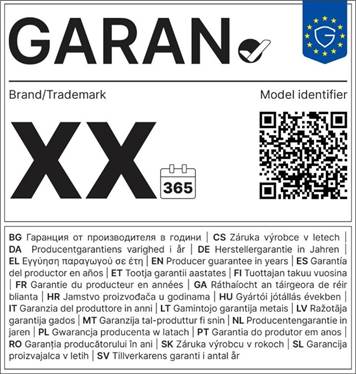
Unfortunately, there is currently no template that obligated parties can use for the specific implementation/customisation of warranty notices.
These new labels must be used from 27 September 2026 onwards. It is therefore advisable to begin implementing the legal requirements immediately.
II. Right to repair
We have already reported several times in this blog on the European Directive on the promotion of the repair of goods (Directive (EU) 2024/1799) (most recently: Further Update on the Right to Repair
). Since 15 January 2026, the draft bill from the Federal Ministry of Justice has been available, which is intended to transpose the provisions of the directive into German law.
In line with the Directive, the law is intended to regulate two core areas. On the one hand, the new right to repair outside of statutory warranty and, on the other hand, important changes to warranty law under sales law.
The new right to repair will apply outside the scope of warranty law to goods purchased by consumers. It only covers the product groups listed in Annex II of the Right to Repair Directive (cf. Sec. 479a German Civil Code (BGB)).
The manufacturer’s obligation to repair, which is at the heart of the new regulation, is implemented in Sec. 479b BGB. The German legislature has opted for a statutory consumer right rather than a (unilateral) obligation to contract. According to this, the manufacturer is obliged to repair the defective goods within a reasonable period of time. The actual scope and time frame of this repair obligation is set out in the ecodesign acts listed in Annex II to the Directive. The manufacturer may charge a reasonable fee for the repair. If the repair is unsuccessful, the consumer will be entitled to warranty claims against the manufacturer under the law governing contracts for work and services.
In addition, manufacturers are obliged to provide information about their repair obligations and corresponding recommended prices, Sec. 479d BGB.
Furthermore, selective but highly practical changes to warranty law under sales law are being implemented in German law.
For example, the reparability of goods becomes part of the normal quality in Sec. 434 (3) sentence 2 BGB and thus part of the definition of a physical defect.
Even more relevant for retailers is the introduction of an obligation to provide information to consumers in the new Sec. 475(4) of the German Civil Code (BGB). In future, consumers as buyers must be informed before remedial action is taken that they have the right to choose between repair and replacement and that the limitation period for the warranty is extended if they choose remedial action.
This is accompanied by the most important change in purchase warranty law in practical terms. According to Sec. 475e (5) BGB, if remedial action is taken in the form of repair (i.e. by repairing the goods), the limitation period for warranty claims is extended once by 12 months. This means that the limitation period for consumer claims will be extended from two to three years in this case. This significant extension will affect all B2C sellers.
These changes will apply from 31 July 2026.
III. Act Amending Consumer Contract and Insurance Contract Law
The ‘Act Amending Consumer Contract and Insurance Contract Law,’ which was passed shortly before Christmas, brings some relief for consumers. When it comes into force in June 2026, it will significantly simplify the revocation of contracts concluded on the internet.
B. Competition law
In competition law, the focus in 2026 will continue to be on the use of green claims:
Even though the Green Claims Directive is still pending, the so-called EmpCo Directive (EU) 2024/825 introduces several important restrictions on the use of green claims in the future. These are to be incorporated into the German Unfair Competition Act (UWG) with the Third Act Amending the Unfair Competition Act.
The Act contains the following relevant prohibitions on the use of green claims:
- The following aspect is included as a new prohibited misleading practice: making an environmental claim about future environmental performance without clear, objective and verifiable commitments, without a corresponding implementation plan and without verification by an external expert (Sec. 5 (3) No. 4 UWG, new version).
- New misleading practice (as new item 2a of the ‘black list’): Affixing a sustainability label that is not based on a certification system or has not been established by government agencies. The certification system required in this respect is also defined in detail; in particular, it requires monitoring of compliance with the requirements by an independent third party.
- New misleading practice (as new No. 4a of the ‘black list’): Making a general environmental claim where the business operator cannot prove the outstanding environmental performance to which the claim refers. This could become the most important provision in practice.
- New misleading practice (as new No. 4b on the ‘black list’): Making an environmental claim about the entire product or business activity when it actually refers only to a specific aspect.
- New misleading practice (as new No. 4c on the ‘blacklist’): Making a statement claiming that a product has a neutral, reduced or positive impact on the environment in terms of greenhouse gas emissions,
The Commission has recently published FAQs on these situations. However, the answers are largely limited to reproducing the wording of the respective provision or the applicable legal regulation. They are therefore of rather limited value in practice.
Furthermore, this document indicates that the European Commission does not currently anticipate any further transition periods for compliance with these obligations beyond the implementation deadline for the Directive. Despite efforts by interested parties, it therefore remains likely that the new regulations will apply from 27 September 2026. The measures proposed by the Commission in the FAQs to ensure compliance, in this case the affixing of stickers to product packaging or additional information at the point of sale, will in many cases not be practicable or economically viable. It may therefore be necessary to dispose a significant number of products that are no longer marketable after the deadline, which is certainly not in line with the purpose of the Directive.
Due to the imminent application of the new regulations from 27 September 2026, all companies that use (or wish to use) green claims should take immediate action to ensure compliance with the new and significantly stricter competition law requirements.
C. Civil procedure law
In addition to the topics discussed above, changes in civil procedure law will also have a noticeable impact on product-related litigation before civil courts.
I. Higher thresholds for jurisdictional competence and legal remedies
Since 1 January 2026, higher thresholds apply to jurisdictional competence and legal remedies. In civil matters, the dispute value limit for the jurisdiction of local courts is now EUR 10,000.00. At the same time, legal representation is now mandatory only for disputes with a value of EUR 10,000.00 or more. The increase applies to all proceedings pending as of 1 January 2026.
The value limits for appeals have also increased at the turn of the year. The minimum value limit for appeals in civil matters is now EUR 1,000 (instead of EUR 600.00). At the same time, the value limit for appeals against non-admission to the Federal Court of Justice (now EUR 25,000.00) and the value limit for appeals against costs (now EUR 300.00) have also increased.
II. Additional special chambers at regional courts
While civil disputes with a value of up to EUR 10,000.00 are now handled by local courts, certain types of cases have been assigned to regional courts since the turn of the year, regardless of their value. These include disputes arising from public procurement law, press and media law disputes concerning publications, and medical malpractice cases.
III. Testing of online proceedings
Shortly before Christmas, the ‘Act on the Development and Testing of Online Proceedings in Civil Justice’ was also passed. This creates the framework for testing a purely digital online procedure. In addition, a digital platform for communication between the court and the parties to the proceedings is to be created and tested.
IV. Digitalisation of debt enforcement
Debt enforcement is also to be digitalised. In future, both the initiation of debt enforcement and the subsequent exchange of documents between lawyers (or authorities) and enforcement officers will largely take place electronically. The Federal Government’s draft bill on the further digitalisation of debt enforcement is currently being discussed in the Legal Affairs Committee.
Do you have any questions about this news item or would you like to discuss it with the author? Please contact: Dr Florian Niermeier