What’s changing in 2026: Chemicals legislation

What’s changing in 2026: Chemicals legislation

As in previous years, chemicals legislation will undergo a wide range of changes in 2026, posing considerable challenges for affected companies.

This year, there’s a special focus on tweaking and adjusting rules to make things simpler, including cutting down on red tape. But there are also some big new requirements and changes to the legal basis, like the “One Substance, one assessment ” package that’s already come into effect. Further legal changes aimed at correcting regulatory misdevelopments will also be of particular practical relevance. The following article addresses some of the relevant changes in the scope of application of various chemical legislation acts.

A. REACH

Even though the European Commission’s proposal for a revision of Regulation (EC) No. 1907/2006 (“REACH“) is still pending, the existing legal framework once again provides scope for a wide range of new requirements. Particularly, the procedure for restricting PFAS will be the focus of attention in 2026.

I. Revision

The targeted revision of REACH remains on the agenda. Not least due to the numerous adjustments made by the Commission’s so-called omnibus proposals last year, regular revision processes, such as those relating to REACH, are subject to further delays. For example, in connection with the so-called environmental omnibus of 10 December 2025, the Commission has only very sparingly stated that a targeted revision of REACH is intended. However, no further announcements on the timetable are currently available.

It is noteworthy, however, that the Commission apparently also wants to use the REACH revision to examine further possibilities for simplification and, if necessary, combine corresponding approaches with its proposal. In view of the approaches developed under the Green Deal and the Commission’s recent ambitious considerations for adapting REACH, it remains questionable whether and, if so, to what extent the REACH revision will actually bring about simplifications.

II. Substance and dossier evaluation

The draft Community Rolling Action Plan (CoRAP) for 2026-2028 was presented on 9 December 2025 and is currently being finalised. It is scheduled to be adopted at the next Member State Committee meeting (expected to take place from 9 to 13 February 2026). The draft CoRAP contains 28 substances, including 8 new substances compared to the current CoRAP 2025-2027.

Affected companies should address the substance-specific reasons for concern, review their respective registration dossiers and update them if necessary.

III. Authorisation

Parallel to ongoing discussions and procedures regarding general changes, substance-related regulation under the REACH Regulation continues to develop inexorably.

1. SVHC identification

The ECHA last updated the candidate list on 5 November 2025, adding another substance: 1,1′-(ethane-1,2-diyl)bis[pentabromobenzene] (DBDPE) (EC: 284-366-9, CAS: 84852-53-9). The candidate list now comprises a total of 251 entries, which must be taken into account both for communication in the supply chain in accordance with Art. 33 of REACH and for notifications to the SCIP database. For any notification obligations under Art. 7(2) REACH, a transitional period of a further six months currently applies to the most recently added substance (cf. Art. 7(7) REACH).

In 2025, it was again apparent that the previously established practice of only two updates within 12 months was not being consistently adhered to. As in the previous year, an additional update was made in November 2025. This indicates a trend towards three updates to the Candidate List per calendar year.

The expected addition to the Candidate List at the beginning of 2026 is still pending. According to the decision taken at Member State Committee level, the substance n-hexane (EC No 203-777-6) is to be identified as an SVHC and added to the Candidate List. The candidate list is scheduled to be updated on 4 February 2026. The initial plan to identify 4,4′-methylenediphenol (EC No 210-658-2) as an SVHC was withdrawn before the Member State Committee meeting in December 2025.

Furthermore, the continuous changes to the Candidate List continue to pose challenges for affected companies. This is because communication processes in the supply chain must be reviewed for accuracy and completeness with each change.

2. SCIP database

In connection with the Candidate List, it is also noteworthy that the European Commission has presented a proposal in the Environmental Omnibus to abolish the reporting requirement for information on SVHCs in the SCIP database. On the one hand, it is to be welcomed that the inadequacies of the existing reporting requirements and the database, which have been emphasised by industry for some time, are thus being acknowledged. On the other hand, the European Commission’s proposal should also be a signal to legislators to carefully examine the consequences and benefits of additional requirements before introducing new legal obligations.

According to the European Commission, information transparency is to be ensured in future primarily through the digital product passport. It remains to be seen whether the associated costs for industry and the benefits of greater transparency in the supply chain will be proportionate.

3. Approval requirements

A total of four substances were proposed by ECHA in the 12th recommendation for inclusion in Annex XIV to REACH; however, a decision by the Commission is still pending. The substances concerned are:

SubstanceECCAS
Barium diboron tetraoxide237-222-413701-59-2
Diphenyl(2,4,6-trimethylbenzoyl)phosphine oxide278-355-875980-60
S-(tricyclo(5.2.1.0’2,6)deca-3-en-8(or 9)-yl O-(isopropyl or isobutyl or 2-ethylhexyl) O-(isopropyl or isobutyl or 2-ethylhexyl) phosphorodithioate X4261401-850-9255881-94
Melamine203-615-4108-78-1

The Member State Committee recently discussed the ECHA’s proposals for the 13th recommendation on the inclusion of substances in Annex XIV to REACH. According to this, four substances are currently scheduled for inclusion:

  • UV-326
  • UV-329
  • triphenyl phosphate
  • 2-(dimethylamino)-2-[(4-methylphenyl)methyl]-1-[4-(morpholin-4-yl)phenyl]butan-1-one

The three-month consultation is currently scheduled for February 2026.

Otherwise, there are no expiry dates or application deadlines for substances subject to authorisation in accordance with Annex XIV for the year 2026.

IV. Restrictions

In 2026, the requirements for a number of existing restrictions will also change:

1. Entry 63 (lead and its compounds)

According to paragraph 15 of entry 63 in Annex XVII to REACH concerning lead and its compounds, there is a general ban on the marketing of articles made of polymers or copolymers of vinyl chloride (“PVC”) if the lead concentration is 0.1% by weight or more of the PVC material. Paragraph 18 provides for an extended transition period until 28 May 2033 for certain articles if the lead concentration is less than 1.5% by weight of the recovered rigid PVC. However, a further restriction will apply from 28 May 2026. From this date, rigid PVC made from profiles and sheets

  • for external applications in civil engineering works, except for decks and terraces;
  • for decks and terraces, provided that the recovered PVC is used in a middle layer and is completely covered with a layer of PVC or another material with a lead concentration of less than 0.1% by weight;
  • for use in concealed areas or cavities in civil engineering works (provided that they are not accessible during normal use, except for maintenance purposes, e.g. cable ducts);
  • for interior applications in buildings, provided that the entire surface of the profile or panel facing the occupied areas of a building after installation is made of PVC or another material with a lead concentration of less than 0.1% by weight,

shall be recovered and used only for the manufacture of new products in one of these categories.

2. Entry 77 (Formaldehyde)

From 6 August 2026, the restriction on formaldehyde under entry 77 in Annex XVII to REACH will apply. From this date, articles may no longer be placed on the market if the test conditions specified in Appendix 14 to Annex XVII to REACH exceed the following values for the concentration of formaldehyde released from these articles:

  • 0.062 mg/m3 for furniture and wood-based products;
  • 0.080 mg/m3 for products other than furniture and wood-based products.

The restriction does not apply to

  • articles in which formaldehyde or formaldehyde-releasing substances are present exclusively in a natural form in the materials from which the articles are made;
  • products intended exclusively for outdoor use under foreseeable conditions;
  • products in buildings that are used exclusively outside the building envelope and vapour barrier and from which no formaldehyde is released into the indoor air;
  • products intended exclusively for industrial or commercial use, unless formaldehyde released from them leads to exposure of the general public under foreseeable conditions of use;
  • Products to which the restriction in entry 72 applies;
  • Products that are subject to Regulation (EU) No 528/2012 of the European Parliament and of the Council as biocidal products;
  • Products falling within the scope of Regulation (EU) 2017/745 of the European Parliament and of the Council;
  • personal protective equipment within the scope of Regulation (EU) 2016/425;
  • Articles intended to come into direct or indirect contact with food falling within the scope of Regulation (EC) No 1935/2004;
  • used products.

3. Entry 78 (synthetic polymer microparticles)

According to entry 78 in Annex XVII to REACH, suppliers of in vitro diagnostic medical devices, including products within the scope of Regulation (EU) 2017/746, containing synthetic polymer microparticles must, from 17 October 2026, provide instructions for use and disposal to professional users and the general public, explaining how to prevent the release of synthetic polymer microparticles into the environment.

In addition, reporting obligations under paragraph 11 of entry 78 in Annex XVII to REACH must be fulfilled by 31 May 2026. By that date, manufacturers and downstream industrial users of synthetic polymer microparticles in the form of granules, flakes and powders used as starting materials for plastic production in industrial facilities must provide the following for the reporting period from 1 January 2025 to 31 December 2025

  • a description of the uses of synthetic polymer microparticles;
  • for each use of synthetic polymer microparticles, general information on the identity of the polymers used;
  • for each use of synthetic polymer microparticles, an estimate of the quantity of synthetic polymer microparticles released into the environment during the previous calendar year, including the quantity of synthetic polymer microparticles released into the environment during transport;
  • for each use of synthetic polymer microparticles, an indication of the exemption referred to in paragraph 4(a) of entry 78 in Annex XVII to REACH

to ECHA.

4. PFAS

Beyond the existing restrictions, the ongoing restriction process concerning PFAS remains of central importance for almost all industrial sectors. Now that the technical evaluation of the restriction proposal by the relevant ECHA committees, i.e. the Committee for Risk Assessment (RAC) and the Committee for Socio-economic Analysis (SEAC), has been largely completed, further consultation on the SEAC draft is expected from March 2026 onwards, according to recent announcements. For affected companies, this consultation represents the last opportunity expressly provided for in the procedure to influence the design of the future restriction by submitting information. Once the consultation has been completed, ECHA will finalise the restriction proposal and forward it to the Commission for further decision.

5. Chromium VI

In addition, the process of restricting chromium VI will also continue. The European Commission has published an updated version of the Q&A document “Towards a restriction of hexavalent chromium (Cr(VI)) substances”. The ongoing authorisation procedures and developments regarding restrictions are to be further coordinated. This will also be facilitated by a draft implementing act that was discussed in the REACH Regulatory Committee: CMTD(2025)2107 – Register for the committee procedure. The RAC and SEAC opinions on the restriction proposal are currently expected by the third quarter of 2026, and a restriction (including amendments to Annexes XIV and XVII) could then be adopted in the course of 2027.

B. CLP

At the end of 2024, far-reaching amendments to Regulation (EC) No 1272/2008 (“CLP”) were introduced by Regulation (EU) 2024/2865. However, Regulation (EU) 2025/2439 recently postponed the date of application of the transitional provisions of Regulation (EU) 2024/2865 (see our blog post for details).

However, the postponement of the date of application (“stop-the-clock“) is only the first part of Omnibus Package VI: Chemicals. In a second part, further adjustments to the content are to be made, including with regard to the changes introduced by Regulation (EU) 2025/2439. In particular, flexibility is to be created with regard to font sizes and labelling. The exemptions from labelling requirements for small containers are also to be extended. In addition, the requirements for updating labels and the mandatory information in advertising are to be changed. The parliamentary process is still ongoing, so further developments remain to be seen.

This year will see the first application of the newly introduced Art. 37(7) CLP. This provision establishes the Commission’s authority to carry out harmonised classifications for substances that have been subject to previous SVHC identification procedures or that have been evaluated as active substances in accordance with Regulation (EU) No 528/2012 or Regulation (EC) No 1107/2009 and which subsequently fall under the newly introduced hazard classes ED HH Cat. 1, ED ENV Cat. 1, PBT or vPvB, without the need for a further evaluation procedure. An initial proposal has been put forward and covers 115 substances. It includes 52 new entries and corresponding changes for 63 entries. A delegated act amending Table 3 of Part 3 of Annex VI to the CLP is expected to be published in the course of the year.

C. BPR

A key focus remains on continuing the work programme under Regulation (EU) No 528/2012 (“BPR”), along with updating and revising the relevant Delegated Regulation (EU) No 1062/2014. As usual, ECHA is pointing out any deadlines for 2026.

In this context, additional data requests are also being made in pending procedures for active substance approval or product authorisation. This applies in particular to ongoing procedures concerning in-situ systems following the adoption of the “BPC Recommendations” for the evaluation of so-called “in-situ” systems.

Particular attention should also be paid this year to the Commission’s proposal to extend the data protection periods under Art. 95(5) BPR for all active substance-product type combinations for which a decision on active substance approval has not been taken by 7 June 2018. The extended deadline is now set to end on 31 December 2030. For data that was not protected under the previous regulation from 31 December 2025 until the new regulation came into force, eligible data owners are to receive additional compensation if the data was used by third parties. However, the claim must be asserted and enforced by the data owner on a case-by-case basis.

On the one hand, it is to be welcomed that the European Commission is showing a willingness to correct a tangible lack of clarity and unintended undesirable developments in the BPR. On the other hand, however, the previous mistake is being repeated. The duration of the work programme for existing substances and corresponding product types was extended until 31 December 2030 by Delegated Regulation (EU) 2024/1398, so that the adjustment of the data protection periods now provided for in Art. 95(5) BPR will (once again) expire precisely at the end of the work programme. However, should there be further delays in completing the work programme, the situation that arose at the end of 2025 would recur at the end of 2030. A more flexible design of the data protection rules under Art. 95(5) BPR would have been desirable in this respect. However, as the European Commission rejects a further extension of the work programme beyond 2030 under the existing legal framework anyway, a more flexible approach was not to be expected. It remains to be seen, however, whether supplementary or new regulatory approaches will be established in the course of the further review of the BPR itself.

The consultation on the possible revision of the BPR will continue until 5 March 2026, but participation has been extremely low so far.

D. POP

The inclusion of further substances in Annex I to Regulation (EU) 2019/1021 (“POP”) is scheduled for 2026. Most recently, the European Commission proposed the inclusion of MCCPs, chlorpyrifos and C9-21 PFCAs and conducted a consultation on this at the end of 2025. It is expected that the legal act for the inclusion of these substances in the POP Regulation will be adopted in the course of 2026.

E. Data platform

Regulation (EU) 2025/2455 establishing a common data platform for chemicals and laying down rules to ensure that the data contained therein is discoverable, accessible, interoperable and reusable, as well as creating a monitoring and prospective framework for chemicals, was published in the Official Journal of the EU on 12 December 2025.

1 January 2026 marks the start of the three-year period within which the chemical data specified in Annex IV to Regulation (EU) 2025/2455 must be included in the common data platform.

According to Art. 4(1) of Regulation (EU) 2025/2455, the Commission shall, by 2 July 2026, adopt an implementation plan by means of an implementing act specifying the chemical data sets to be included in the common data platform, together with a timetable for their inclusion.

In addition, from 1 January 2026, researchers or research consortia funded by Union framework programmes or national programmes will be required to make data available to the EEA in relation to human biomonitoring data and to the ECHA in relation to relevant data on environmental sustainability.

The “observatory” for certain chemicals or groups of chemicals to be established under Art. 23 of Regulation (EU) 2025/2455 will also be of particular relevance. To this end, the European Commission will adopt and publish a list of chemicals to be subject to additional testing by 2 July 2026.

F. Conclusion and outlook

The manifold changes and readjustments mean that chemicals legislation will remain a complex, demanding and challenging subject in 2026. The European Commission’s latest “corrective measures” concerning, for example, the SCIP database, CLP and BPR do not exactly strengthen the position of those companies that made early efforts to achieve legal compliance.

Regardless of this, however, companies must still keep a close eye on the many changes. What’s more, beyond the changes in the central legal acts of European chemicals regulation, there are a variety of regulations that focus on specific hazardous properties of substances in products, establishing bans for the placing on the market or use of affected products or further transparency requirements. Corresponding provisions in ESPR, PPWR and many other regulations underscore this. Chemicals legislation thus emphatically and conclusively proves that it is a horizontal regulatory matter that affects companies from all industries, all stages of the supply chain and of all sizes. This makes it all the more important to address the ongoing changes and develop robust internal company monitoring systems in order to identify existing obligations and (liability) risks at an early stage, as well as potential opportunities that may arise from regulatory changes.

Do you have any questions about this news item or would you like to discuss it with the author? Please feel free to contact: Martin Ahlhaus


22. January 2026 Martin Ahlhaus

Regulation (EU) 2025/2439 – Postponement of the rules on classification, labelling, and packaging of chemicals until 2028

With Regulation (EU) 2025/2439, the Parliament has decided to postpone the date of application of the transitional provisions of Regulation (EU) 2024/2865 amending the CLP.

This Regulation was published on 03.12.025 in the Official Journal of the European Union (see OJ L, 2025/2439, 3 December 2025) and enters into force on 23.12.2025.

This affects the following requirements under the CLP:

  • Format of labelling, such as the legibility of labels, e.g. appropriate font size in relation to the size of the label
  • Deadlines for re-labelling in the event of changes to classification
  • Information requirements for advertising, including online advertising
  • Information requirements for distance selling offers, e.g. labelling elements comparable to those of the physical CLP label in accordance with Art. 17 CLP, and
  • Labelling requirements for petrol stations.

The specific content of these aspects is still to be determined. The proposal COM (2025) 531 final or 2025/0531 (COD) provides indications as to what this redesign might be. Its implementation is still pending. Regulation (EU) 2025/2439 deals exclusively with the postponement of the transitional provisions.

Originally, according to Regulation (EU) 2024/2865, the new CLP requirements for the above-mentioned aspects would have had to be implemented with a transition period until 01.07.2026 or 01.01.2027, depending on the respective provision. Regulation (EU) 2025/2439 has now postponed the date of application of these transitional provisions to 01.01.2028. Nevertheless, companies are of course free to apply the new provisions introduced by the aforementioned regulation voluntarily before the date of their application.

The reason for this is the EU’s ‘Omnibus Initiative’, which aims to simplify laws and directives in order to reduce bureaucracy. OMNIBUS VI aims to simplify regulations for the chemical industry (see European Chemicals Industry Action Plan, 8 July 2025). Regulation (EU) 2025/2439 forms the first part of the Omnibus VI package.

The second part of the Omnibus VI package is eagerly awaited. Changes to the content of the CLP have been announced. It remains to be seen whether this will allow a comprehensive revision of the CLP to be pushed through in a streamlined procedure.

Further links:

Regulation (EU) 2025/2439 (stop the clock CLP) is available at: https://eur-lex.europa.eu/legal-content/DE/TXT/?uri=OJ:L_202502439.

The proposal COM (2025) 531 can be viewed at: https://single-market-economy.ec.europa.eu/publications/simplification-certain-requirements-and-procedures-chemical-products_en.

Do you have any questions about this news or would you like to discuss it with the author? Please contact: Nicole Rauch and Martin Ahlhaus

5. December 2025 Nicole Rauch

What’s changing in 2025: Chemicals legislation

Like in previous years, chemicals legislation will remain an unstable legal matter that is and will remain subject to continuous change – also in 2025.

This is particularly true due to the increasing tendency of legislators to explicitly interlink different regulatory areas – for example, the inclusion of “substances of very high concern” in the regulatory system of Regulation (EU) 2024/1781 (“ESPR”) or the relevance of banned “chemical substances” for the assessment of the risk level in accordance with Annex II point 4.1 d) to Delegated Regulation (EU) 2024/3173.

The pending adoption of the regulatory package on the OSOA approach (“one substance – one assessment”) will further support this trend. In addition to a standardized data platform for information on substances, inter alia the reassignment of tasks to the European Chemicals Agency (“ECHA”) is also planned, for which a new basic regulation is to be issued at the same time.

This will further increase the importance of substance-related requirements in the field of product compliance. In addition to these future regulations, there is also the need to comply with and implement numerous legal amendments from previous years, which will now come into force in 2025. This article highlights some key aspects that need to be kept in mind.

A. REACH

With regard to the REACH Regulation, various aspects are relevant that deserve attention in 2025.

I. Revision

Even though this process has recently come to a significant standstill, a revision of Regulation (EC) No. 1907/2006 (“REACH”) is still pending. Even under the new Commission, efforts to simplify the legal requirements remain an integral part of the political agenda. The amendments are to form part of a future “Chemicals Industry Package”. While extensive proposals have already been drawn up and submitted by industry, the Commission’s political agenda in this area has yet to be fleshed out. It remains to be seen whether and to what extent the Commission will take up or modify previous considerations on the revision of REACH. The focus here is on the revision of authorisation and restriction procedures, including the introduction of a generic risk assessment approach, the extension of registration obligations (e.g. to certain polymers) or the expansion of data requirements. The further implementation of requirements in accordance with the “safe and sustainable by design” concept, the introduction of “non-toxic material cycles” and the establishment of an “essential use concept” will also continue to be the focus of the revision of REACH.

II Substance and dossier evaluation

On December 10, 2024, ECHA submitted a draft update of the “Community Rolling Action Plan (CoRAP)” for the years 2025 to 2027. For the year 2025, four substances already addressed in the CoRAP are planned for further evaluation, while a further four substances have been added for the year 2025.

ECHA has already pointed out that registrants of the substances concerned should review their respective registration dossiers and, if necessary, complete them by March 2025 to ensure that all necessary information is included.

In addition, all registrants should also bear in mind that the application of the hazard classes introduced by Delegated Regulation (EU) 2023/707 and the associated hazard statements will become mandatory for substances placed on the market from 01.05.2025. The corresponding requirements should therefore also be taken into account in any dossier updates. 

III List of candidates for authorisation

ECHA last updated the candidate list on 7 November 2024 and added another substance, triphenyl phosphate (EC: 204-112-2, CAS: 115-86-6). Since then, the candidate list has comprised a total of 242 entries, which must be taken into account directly both for communication in the supply chain in accordance with Art. 33 REACH and for notifications in the SCIP database. For any notification obligations under Art. 7 para. 2 REACH, a transitional period of a further six months applies to the most recently added substance (see Art. 7 para. 7 REACH).

If ECHA were to follow the established practice of two updates within 12 months, a further addition to the candidate list would not be expected until the middle of the year. However, ECHA departed from the usual practice with the addition to the candidate list on 07.11.2024 and made an additional, third addition to the list in 2024 (following the amendments of 23.01.2024 and 27.06.2024). The regular addition to the list of candidates at the beginning of 2025 is still pending. As can be seen from the minutes of the 88th meeting of the Member States Committee on 12.12.2024, a further addition to the candidate list is to be made as early as 21.01.2025, with which the following substances are to be added:

  • Octamethyltrisiloxanes (EC: 203-497-4, CAS: 107-51-7);
  • O,O,O-triphenyl phosphorothioate (EC: 209-909-9, CAS: 597-82-0);
  • Reaction mass of: triphenylthiophosphate and tertiary butylated phenyl derivatives (EC: 421-820-9, CAS: 192268-65-8);
  • Perfluamine (EC: 206-420-2, CAS: 338-83-0);
  • Tris(4-nonylphenyl, branched and linear) phosphite (EC: -, CAS: -);
  • 6-[(C10-C13)-alkyl-(branched, unsaturated)-2,5-dioxopyrrolidin-1-yl] hexanoic acid (EC: 701-118-1, CAS: 2156592-54-8).

This poses a number of challenges for affected companies, as communication processes in the supply chain now have to be reviewed or updated in quick succession.

IV. Authorisation requirements

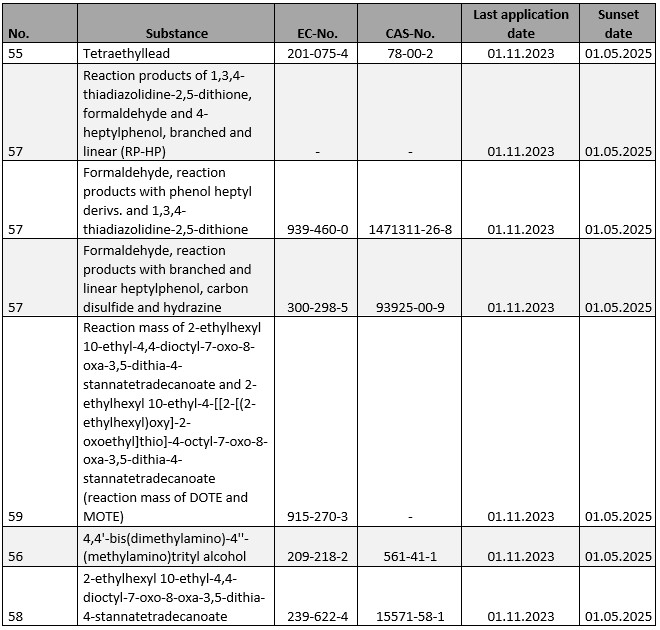
For a number of substances subject to authorisation in accordance with Annex XIV to REACH, the expiry date will be reached in the current year, i.e. the date from which the respective substance may no longer be used as such or as a constituent of mixtures, unless a corresponding application for authorization has already been submitted in due time before 01.11.2023 (see our outlook for 2023) or one of the few general exemptions intervenes . The following substances are affected:

It is worth mentioning that, according to the minutes of the 88th meeting of the Committee of Member States of 12.12.2024, the approach for prioritizing substances for inclusion in Annex XIV is also to be revised. In addition to a thoroughly appropriate, critical review and, if necessary, supplementation of the existing decision parameters, it would certainly be desirable if the prioritization process were also more transparent with regard to individual decision-making processes.

V. Restrictions

For a number of restrictions, previous exemptions or transitional regulations will expire in 2025, for example for

  • the use of diaphragms containing chrysotile in electrolysis installations (see No. 6 in Annex XVII to REACH; deadline: 01.07.2025);
  • the use of lead and its compounds in articles made from polymers or copolymers of vinyl chloride (“PVC”) if the concentration of lead is 0.1% or more by weight of the PVC material and if the articles contain recovered flexible PVC (entry No. 63 in Annex XVII to REACH; deadline: 28.05.2025);
  • the use of C9-C14-PFCA, their salts and C9-C14-PFCA-related substances for (i) photolithographic or etch processes in semiconductor manufacturing, (ii) photographic coatings applied to films, (iii) invasive and implantable medical devices and (iv) certain firefighting foams (entry No. 68 in Annex XVII to REACH; cut-off date 04.07.2025)
  • the use of N,N-dimethylformamide for placing on the market for use or for use as a solvent for dry and wet spinning of synthetic fibers (entry No. 76 in Annex XVII to REACH; deadline: 12.12.2025).

or further obligations are added for the first time, such as

  • the obligation of suppliers of synthetic polymer microparticles as such or in mixtures for use in industrial plants to provide additional information and instructions in future (see entry No. 78 in Annex XVII to REACH, reference date: 17.10.2025);
  • the obligation for suppliers of products placing synthetic polymer microparticles on the market in the form of a food additive to provide instructions for use and disposal to professional users and the general public explaining how to prevent the release of synthetic polymer microparticles into the environment ; the same obligation applies to suppliers of synthetic polymer microparticles,
    • which are contained by technical means to prevent release to the environment when used as directed during the intended end use;
    • whose physical properties are permanently altered during the intended end use in such a way that the polymer no longer falls within the scope of this entry;
    • which are permanently integrated into a fixed matrix during the intended end use (see entry No. 78 in Annex XVII to REACH, reference date: 17.10.2025).

Irrespective of this, the further progress of the discussions on the proposal to restrict PFAS will of course continue to be monitored. Further discussions on sector-specific exemptions and transitional provisions are planned for the current year and new regulatory approaches are also to be discussed, according to the update on the process published at the end of last year.

B. CLP

Following the introduction of new hazard classes (EDs, PBTs, PMTs, etc.) by a delegated act in 2023, the year 2025 will be dominated by preparations for the implementation of the revised requirements of Regulation (EC) No. 1272/2008 (“CLP”), which was recently amended by Regulation (EU) 2024/2865. This regulation, published in the Official Journal of the EU on 20.11.2024, amends specific requirements for the classification of substances with multiple constituents, provides for a new version of Art. 10 CLP regarding concentration limits, M-factors and acute toxicity estimates for the classification of substances and mixtures and introduces specific requirements for the supply of hazardous substances and mixtures via so-called “refill stations”.

However, the most practically significant complex of changes concerns aspects of labeling. The requirements for the design of labels (previously addressed in part by the corresponding guideline) have now been explicitly integrated into Annex I to CLP (e.g. on color, font type and size, line spacing, etc.). The regulations for updating labels in Art. 30 CLP have also been updated and clarified.

Chemicals legislation has rightly always been a cross-cutting issue of product legislation. The new version of CLP now takes this up in concrete terms and provides in Art. 25 para. 9 CLP, for example, that label elements resulting from requirements of other Union legal acts must be included in the section with supplementary information on the label (according to CLP!). This means that such requirements are uno actu also subject to the specific design requirements and format specifications of the revised CLP. This is because the section with supplementary information is also an element of the label and is therefore also subject to the design requirements according to Section 1.2.1.5 in Part 1 of Annex I to CLP.

This alone shows that suppliers of hazardous substances and mixtures will face significant changes in the coming years, which will require early preparation. Regulation (EU) 2024/2865 provides for transitional provisions for the application of the new requirements (until 01.07.2026 and 01.01.2027, respectively) and also introduces an additional sell-off period until 01.07.2028 or 01.01.2029 for “old stocks” already in the supply chain. However, goods that are placed on the market for the first time after the date of application or that are to be placed on the market after expiry of the sell-off periods must meet the new requirements (see Art. 61 paras. 7, 8 CLP) in order to avoid a marketing ban (see Art. 4 para. 10 CLP). Even if the transitional provisions seem comparatively generous, the timeframe for cleaning up entire supply chains and any stocks remains ambitious.

C. Biocides

In biocide law, both EU legal developments in the BPR and national developments in the ChemBiozidDV must be taken into account for the year 2025.

I. BPR

At European level, the main focus continues to be on proceeding with the work program under Regulation (EU) No 528/2012 (“BPR”), together with the corresponding update of the relevant Delegated Regulation (EU) No 1062/2014. ECHA points out any deadlines for 2025 in the usual way here.

In this context, additional data requests are also recorded in pending procedures for active substance approval or product authorization. Applicants should also be prepared for this in 2025 if the evaluating authorities see reason to do so due to the adjustments and updates to guidelines and recommendations for the evaluation. In this context, the “BPC Recommendations” for the assessment of so-called “in-situ” systems, which are expected for spring 2025, will also be of particular relevance. More than 12 years after the BPR came into force, these are intended to specify the framework conditions for the data requirements and assessments of in-situ systems in a way that takes into account the actual and technical peculiarities of the on-site production of biocidal products – and also reveal in detail how little the BPR had such systems in mind, even though they were expressly included in the scope of application from the outset. For practical approaches, the legal requirements of the BPR will at least have to be “stretched” considerably. Overall, however, it is to be welcomed that ECHA and the competent authorities of the Member States have dedicated themselves to the topic with great commitment, in order to provide more clarity to the relevant procedures – also in the interests of the applicants.

II. ChemBiozidDV

At national level in Germany, the year 2025 has already started with the introduction of the ban on self-service offers and the application of further sales restrictions for certain biocidal products in accordance with the ChemBiozidDV. Since 01.01.2025 a self-service ban applies to biocidal products,

  • if one or more uses of these products are not permitted for the general public according to the labeling specified by the authorisation in accordance with the BPR; or
  • which are still marketable without authorisation according to the BPR due to applicable transitional provisions and are assigned to product types 14, 18 or 21 according to Annex V of the BPR,

i.e. these products may only be offered and dispensed in a form in which the purchaser does not have free access to the biocidal product (see Sec. 10 para. 1 No. 2 ChemBiozidDV).

In addition, the purchaser must be given further verbal instructions (see Sec. 10 para. 2 in conjunction with Sec. 11 ChemBiozidDV), further requirements apply to online and mail order sales (Sec. 12 ChemBiozidDV) and the sale may only be facilitated by a person who has sufficient expertise as required for the sale (Sec. 13 ChemBiozidDV).

Furthermore, biocidal products that are subject to transitional provisions in accordance with the BPR and are assigned to product types 7, 8 or 10 according to Annex V of the BPR may only be placed on the market if organisational measures ensure that the further oral instruction of the purchaser (see Sec. 10 para. 2 in conjunction with Sec. 11 ChemBiozidDV) is carried out by a sufficiently qualified person (Sec. 13 ChemBiozidDV).

D. POP

Further amendments to Regulation (EU) 2019/1021 (“POPs”) are expected in 2025, after the list of substances included in the underlying Stockholm Convention has already been expanded. The EU’s legal framework still needs to be adapted accordingly.

Beyond this rather formal readjustment of the European legal framework, however, a new interpretation document from the European Commission is causing quite a stir. The document presents a new understanding of the exemption under Art. 4 para. 2 POPs for substances that are present in articles that were already in use before or at the time since the POP Regulation or its predecessor regulation applies to these substances – whichever is earlier. This exemption has so far been interpreted very broadly due to the specifically defined term “use” (see Art. 2 No. 6 POP, which refers to the definition of the same term in Art. 3 No. 24 REACH), as this term includes literally “any utilization” (including storage, for example).

Now, however, use within the meaning of Art. 4 para. 2 POP shall require that the product concerned is already in the possession of the end user. As a result, goods that are still in the supply chain – e.g. in stock at a retailer – but have not yet reached the end user at the corresponding application date would no longer benefit from the exception. Such goods would no longer be marketable and would even have to be disposed of as waste (see Art. 5 para. 1 POP).

The impact of this reinterpretation can hardly be overlooked at present. Of course, the practical relevance will also depend on the level of enforcement. However, the (unexpected) discontinuation of the marketability of inventories alone will cause considerable discussion in countless supply relationships this year if contractual claims or general requirements from a material and product compliance perspective are taken into consideration.

Conclusion and outlook

Chemicals legislation will remain a demanding subject in 2025 and will continue to present companies with considerable challenges. Comparatively low-threshold changes that are often implemented outside the sphere of perception of affected companies – e.g. by merely changing the classification of a substance, extending prohibition regulations to groups of substances or substances/mixtures with certain properties or even changing mere interpretations – can have a considerable economic impact. Without sufficient sensors to detect such developments in the area of material compliance at an early stage, companies in production and trade will no longer be able to act in a targeted manner on the market – or even be able to defend their interests in consultation, application or appeal proceedings at an early stage.

Do you have any questions about this news or would you like to discuss it with the author? Please contact: Martin Ahlhaus

16. January 2025 Martin Ahlhaus